

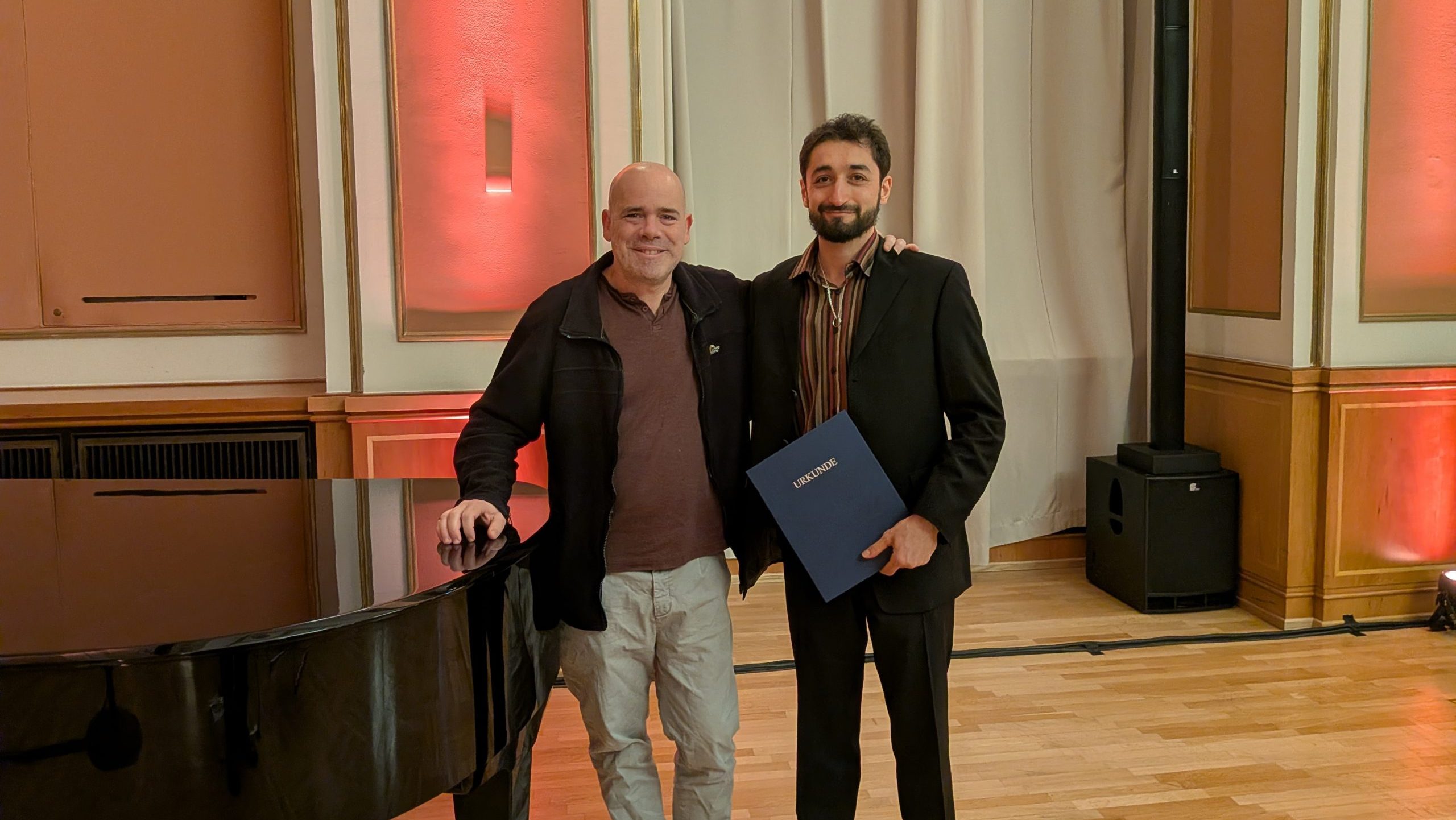
Young Israelis, Palestinians and Germans at one table, in the middle of the Gaza war: An innovative dialogue project received this year’s Shimon Peres Prize. Its organizers, Uri Rosenberg and Tom Khaled Würdemann, talk about new ways of addressing a conflict that has long been dividing German society, too.
Interview by Joshua Schultheis
When Uri Rosenberg and Tom Khaled Würdemann brought young Israelis, Palestinians and Germans together in Heidelberg in the summer of 2025, the war in Gaza was still raging. For a week, the participants met at the Heidelberg University of Jewish Studies (HfJS) to discuss how the Israeli-Palestinian conflict spills over into Germany and affects relations between Jews and Muslims here. The workshop was a joint project of the HfJS and Tech2Peace, a Haifa-based Israeli-Palestinian dialogue organization co-founded by Rosenberg. A second workshop has since taken place in Berlin.
Last week, the project “Upholding Dialogue in Times of Crisis” was honored with the Shimon Peres Prize. The award for German-Israeli civil society projects has been presented annually since 2017 by the German Federal Foreign Office in cooperation with the German-Israeli Future Forum Foundation (DIZF), which Germany and Israel established in 2007. Foreign Minister Johann Wadephul presented this year’s prize, worth a total of 20,000 euros and shared with a second project, at Berlin’s Red City Hall on November 5.
Rosenberg, a Jewish Israeli, and Würdemann, a German Muslim, are both researchers at the HfJS’s Ben-Gurion Chair for Israel and Middle East Studies. In an interview with The Bilateral Briefing about their workshop, they explain why they deliberately invited activists from both sides, what happened when disrupters infiltrated their only public event—and why, of all participants, the Germans were the most deeply moved.
Mr. Rosenberg, Mr. Würdemann, your first workshop took place in Heidelberg in the summer of 2025, while the war was still going on. How relieved were you that it did not have to be canceled after all?
Rosenberg: We were worried because of Iran: There had just been missile attacks on Israel, and we were afraid people would not be able to come if the airspace over Israel and the Palestinian territories was closed again. We were also afraid there might be protests. In the end, we were negatively surprised: We did not expect the amount of hostility we got here in Germany.
What happened?
Rosenberg: We made the mistake of holding one open event. We thought it was under control because people had to sign up, but some signed up under fake names to ruin it. They sat there with flyers that mocked our seminar as “support for the genocide,” and they asked very aggressive questions—directed specifically at the two Muslims on the panel, Tom and Hamza Howidy, a Gazan living in Germany. They singled them out to portray them as bad Arabs, as traitors. It was disgusting; I felt very bad. But Tom and Hamza gave very good answers and got a lot of applause. And in a way, it backfired on the disrupters: Israelis, Palestinians and Germans all felt under attack together, and that brought them even closer together. I’m not saying it was a good thing, but that was the effect.
Würdemann: At this point, I want to give special thanks to the rector of the HfJS, Andreas Brämer, who took the risk of hosting this kind of workshop at a Jewish institution in the middle of the war.
Rosenberg: He had just taken office and knew us only superficially. We pitched the idea, he liked it and gave us his blessing. We had the full support of the HfJS, including a staff member dedicated to helping us with the program, the finances and the logistics.
“The goal was also to bring our Israeli and Palestinian participants to Germany as peace ambassadors, to help defuse the conflict here.” – Uri Rosenberg
Why did you focus on Jewish-Muslim relations rather than on Israelis and Palestinians alone?
Rosenberg: After October 7, 2023, I did a lot of dialogue work with Israelis and Palestinians at Tech2Peace. But when I became a postdoc in Heidelberg, I noticed that it is not only Israelis and Palestinians who are suffering. My students—Jewish Germans, Muslim Germans, other Germans, migrants—were suffering from what was happening in Gaza and, before that, from what happened in Israel on October 7. There was a lot of fear that Germany was becoming an antisemitic place, a place where Muslims are not safe and migrants are hated. And many people were afraid to talk about the conflict at all. Our Tech2Peace alumni have learned how to talk about these things. So I said to Tom: Why not bring our dialogue method to Germany? Young Germans’ great-grandparents may have known something like this in the 1930s, but I don’t think young Germans themselves have ever experienced such a polarized and hateful atmosphere as the one the Middle East conflict has created in Germany today. We wanted to give people a space where they can talk about the conflict respectfully—where they can say whatever they want without being censored, but where they are also listened to and listen to others.
Where exactly did the participants come from?
Würdemann: The Israeli and Palestinian participants were selected by Tech2Peace: Jewish Israelis, Arab citizens of Israel, Palestinians from East Jerusalem and the West Bank, and one person from Gaza. We chose the German participants through an application process. We very much wanted to have many German Jews as well as German Muslims. In Heidelberg, German Muslims applied in large numbers, but only two German Jews took part; in Berlin, where we held our second workshop, there were about eight. Most participants were students, some of them even pro-Israel or pro-Palestinian activists who were brave enough to take a look at the other side. One of the best results of our work is that the people who came in with the strongest opinions changed the most. And because our alumni stay in touch and still do things together, we can see that this change has lasted, a year later.
How did it come about that pro-Palestinian activists also took part in the workshop?
Rosenberg: They applied, and in the selection interview, they sounded reasonable. Some of them were very pro-Palestinian, but they sounded like they were coming to learn and to listen, not just to talk. We wanted pro-Palestinian activists, and we wanted pro-Israel activists. We didn’t want only the peace activists in the middle. People with strong opinions are the ones who can change the most, and they have influence in their own circles: They can go back to other activists and say, “Listen, I met real Israelis and real Palestinians, and this is what I heard.” I also wanted to show our Israeli and Palestinian participants how our conflict is entering Germany and, in a way, poisoning it, making the country very polarized. It made me very sad to see people here shouting at each other. So, ironically, the goal was also to bring Israelis and Palestinians to Germany as peace ambassadors, to help defuse the conflict here. Which is ridiculous if you think about it—but it kind of worked.
It is a heated topic. Did a discussion during the workshops ever explode?
Rosenberg: There were always lots of emotions, but no explosion. In Heidelberg, one session was badly designed; we learned from it and didn’t repeat it in Berlin. But the first workshop was meant to be trial and error—we knew we would make mistakes. We are building something and improving it as we go. Berlin was definitely better than Heidelberg, and next year in Frankfurt, where our next workshop is set to take place, we will do it even better.
What did you as organizers learn about when dialogue works—and when it doesn’t?
Würdemann: As an academic who researches the Israeli-Palestinian conflict, I learned that my intellectualizations, which I always indulge in, cannot resolve situations that come from emotion and from the immediate experience of people living in a conflict. They have needs that cannot be met by talking or by intellectual ideas, but only on the level of life, of friendship, love and emotions.
Rosenberg: I learned that my instinct was right: What we do at Tech2Peace can be copied or adapted to fit Europe. Many people told me: “This is a different culture, it won’t work. The Germans won’t open up, they don’t have much to share.” Tom, on the other hand, believed in the idea from the very first minute. And it turned out that even Germans who are neither Jewish nor Muslim carry a lot of pain from this conflict, although they don’t belong to either side. People really opened up; some of them cried. The Israelis and Palestinians had already met before and done things together. For the Germans in particular, it was life-changing—some said it was one of the most important events of their lives. Here in Germany, we were able to show that our model works outside Israel, too.
Questions or suggestions? Write to us: info@bilateral-briefing.com