

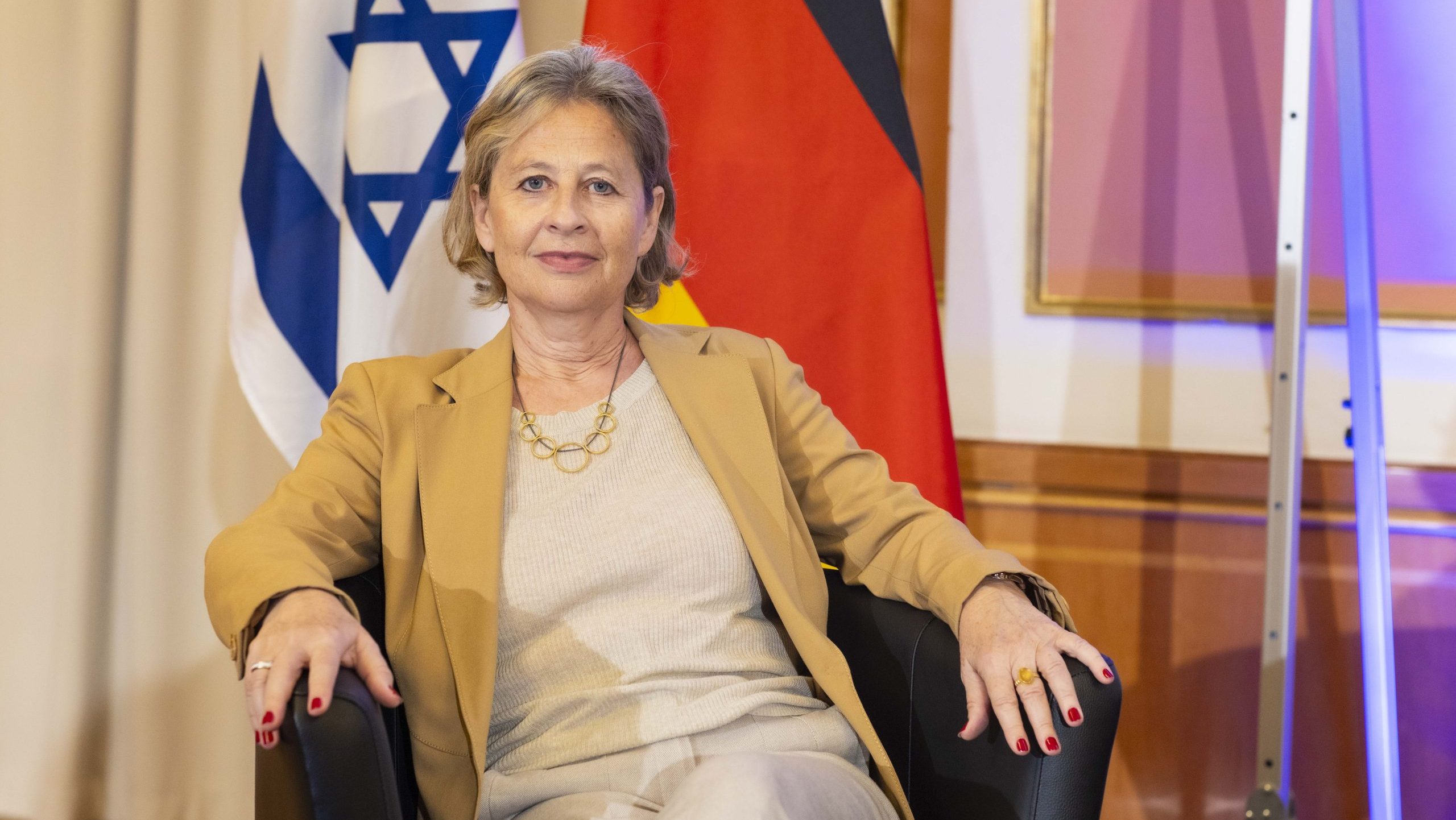
After the election, Israel faces complicated coalition talks. In an interview, Gisela Dachs discusses possible ways out of the deadlock, how Israelis view Germany and the chance of improving ties between the two countries.
Interview by Joshua Schultheis
The Knesset election on October 27 produced no clear winner. Prime Minister Benjamin Netanyahu’s coalition has lost its majority, but the opposition bloc led by his challenger, Gadi Eisenkot, cannot form a government without the Arab parties, some of which are anti-Zionist. A stalemate. Berlin, accordingly, is keeping quiet: the German government has so far not commented on the result.
“It’s an open secret, though, that the German government would like to see a coalition in Israel without extremists,” Gisela Dachs says in an interview with The Bilateral Briefing. She believes a new government in Jerusalem would be a chance to put the strained German-Israeli relationship on a better footing — even if Israel’s security policy changed little at first.
Dachs has been explaining Israel to Germans, and Germany to Israelis, for decades. Born in Bavaria, the 63-year-old is a seasoned international journalist who covered the Middle East for the weekly Die Zeit in the 1990s and is now a professor at the DAAD Center for German Studies at the Hebrew University of Jerusalem. There, she regularly runs surveys on how Israelis and Europeans perceive one another. Hardly anyone is better placed to say how German-Israeli relations are developing.
The Bilateral Briefing: The election in Israel gave a majority neither to the outgoing coalition nor to the opposition camp around Gadi Eisenkot, and many scenarios for what comes next are being floated. Which do you consider the most likely?
Gisela Dachs: Hard to say. There are a few options, and they are all about equally unlikely. One is a grand coalition of Netanyahu, Eisenkot and other parties, which President Isaac Herzog would probably prefer, too. Another is a minority government under Eisenkot that the Arab parties would tolerate. A governing coalition that includes all the Arab parties, the Joint List among them, I consider out of the question for now. But some very creative solutions are being discussed, too.
Such as?
One is a coalition of the Eisenkot bloc with the Arab party Ra’am and the ultra-Orthodox United Torah Judaism, which has been in Netanyahu’s government but has signaled that it is open to switching sides. For that, Eisenkot would have to compromise on the draft law, for instance by providing civilian service for the ultra-Orthodox and the Arabs. Another idea is to change the law to allow a one-time direct election of the prime minister. Netanyahu himself floated that once before. And early new elections are, of course, another possibility.
The German government has so far said nothing about the election in Israel — partly because there is no clear winner. What do you think the view is in Berlin?
They’re taking a wait-and-see approach. But it’s an open secret that the German government would like to see a coalition in Israel without extremists. Ministers like Itamar Ben-Gvir have made it extremely difficult for Germany and other European countries to deal with the Israeli government over the past four years. If those extremist forces were no longer part of the government, it would be much easier to put German-Israeli relations on a better footing.
“German policy on Israel has always been a balancing act, and it has become even harder.” – Gisela Dachs
The sixth Netanyahu government, considered the most right-wing in Israel’s history, put German-Israeli relations through many trials: the controversial judicial overhaul, the Hamas attack of October 7, 2023, and the wars that followed in Gaza, Lebanon and Iran. How would you describe the state of the relationship after these four years?
It is still stable, but it has come under heavy strain. After all, Germany imposed two temporary arms embargoes on Israel during the Gaza war. In Germany, moreover, the notion that Israel’s security is part of the country’s “reason of state” (Staatsräson) is the subject of ever more heated debate. For a long time, there was no need to spell out what exactly this commitment means. But over the course of the Gaza war it has increasingly collided with other principles of German foreign policy, and public support for it has fallen markedly. That has turned the debate into a domestic political issue, too, and made the balancing act that German policy on Israel has always been harder still. It is further complicated by the fact that Germany now relies on Israeli military technology for its own defense.
You have studied for many years how Israelis see Germany and how Germans see Israel. Let’s start with the Israelis: How do they view Germany today, the country that perpetrated the Holocaust, and how has that view changed?
Our data go back to the early 1990s. Asked whether their country’s relationship with Germany can be described as “normal,” Jewish Israelis show an interesting trend: Agreement peaked at 89 percent in 2011. When we started asking the question again in 2022, agreement fell, and in 2026 it stands at just 59 percent. Agreement with the statement that there is a “different Germany” today is also declining. The trend is especially pronounced among young Israelis.
How do you explain that?
It may have to do with developments in Germany since 2015: the rise of the AfD, the refugee crisis and its repercussions.
Your surveys also show that Israelis are increasingly skeptical of the European Union. Does that rub off on how they see Germany?
Definitely. Four years ago, most respondents still saw the EU as a success story; in 2026, only just under 20 percent of Jewish Israelis do. One reason is probably that it has become much harder for Israelis to travel to Europe in recent years, and that they feel increasingly unsafe there. Israelis are now advised for security reasons not to speak Hebrew abroad. That has helped turn Israelis inward since October 7 and made them view other countries, Germany included, more negatively.
Yet your studies also show that Israelis still regard Germany as one of their country’s most important allies.
Jewish Israelis see Hungary as the most Israel-friendly country, with Germany right behind it. Overall, Israelis’ image of Germany is tending to worsen, but compared with the rest of Europe it still does well.
“A new government in Jerusalem could also bring a change for the better in relations between the two countries.” – Gisela Dachs
And the other way around? How is Germans’ image of Israel developing?
We asked Germans how the Gaza war has changed their view of Israel. Nineteen percent said they had become more pro-Palestinian in recent years, eight percent more pro-Israel, and 46 percent said their views hadn’t changed. The rest didn’t know or declined to answer. By comparison, in Poland 30 percent said they had become more pro-Palestinian and only four percent more pro-Israel. In sum, Germans view Israel more negatively today than before October 7, but compared with other countries there has been no dramatic deterioration.
What are the chances that the relationship between Germans and Israelis will improve again in the coming years?
A new government in Jerusalem could also bring a change for the better in relations between the two countries. Admittedly, key pillars of Israeli security policy — on Gaza or Iran, say — wouldn’t change significantly even without Netanyahu, and a Palestinian state wouldn’t move any closer. But sometimes it simply takes new faces to get things moving. It would already help a great deal if the next cabinet had no extremist ministers. That would make it easier not only for politicians but also for the civil societies of both countries to move toward each other. School exchanges and scientific cooperation between the two countries have suffered badly in recent years. There is every reason to hope for a turnaround in those areas.