

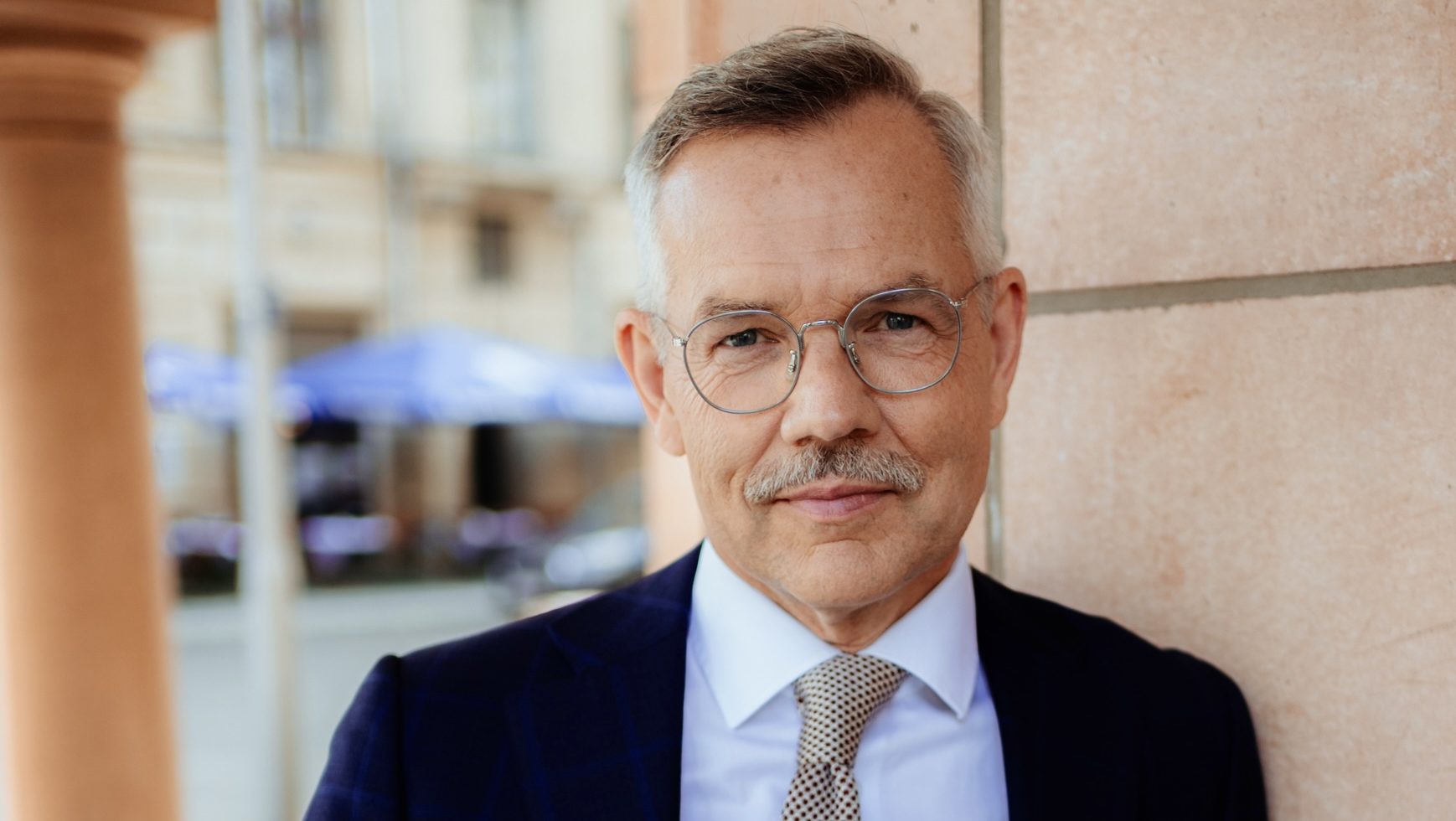
Former Bundestag member Michael Roth (SPD) on the three years since the Hamas attack of October 7, 2023, his criticism of Germany’s Israel policy and his concern that relations between the two countries have suffered lasting damage
Interview by Joshua Schultheis
For many years, Michael Roth was one of Germany’s most influential foreign policy voices. From 1998 to 2025 he represented the Social Democratic Party (SPD) in the Bundestag, Germany’s federal parliament. He served as Minister of State for Europe at the Federal Foreign Office and, most recently, as chair of the Bundestag’s Foreign Affairs Committee. He did not run again in the 2025 federal election and, after leaving front-line politics, founded the consultancy “Freedomfighter.”
Roth’s outspoken pro-Ukrainian and pro-Israeli positions made him a controversial figure—including within his own party. In his book “Zonen der Angst” (“Zones of Fear”), he describes how far he has drifted from the SPD on foreign policy in recent years. He also writes about his horror at the rise of antisemitism and hatred of Israel in Germany since October 7, 2023. The Bilateral Briefing met Roth in Berlin.
The Bilateral Briefing: Mr. Roth, you were an SPD member of the Bundestag and chair of the Foreign Affairs Committee when Hamas attacked Israel on October 7, 2023. How did you experience that day?
Michael Roth: October 7 was a Saturday. For once I had the day off, I wasn’t reading the news and I didn’t answer the phone when the Israeli ambassador, Ron Prosor, tried to call me several times. Only when I got a text message asking me to call back urgently did I realize that something must have happened. I turned on the radio and that is how I learned of the Hamas attack on Israel, even though its full scale was not yet known at that point. Then I spoke to the ambassador on the phone. The Israelis had, of course, already suffered many terrible attacks and much brutal terror. But during that short call it quickly became clear to me: this was a horror of an entirely different dimension.
What did the ambassador want from you?
I perceived that call as a cry for help. He asked me to understand that, given the monstrousness of this massacre by Hamas terrorists, there would be a harsh Israeli response. He said he knew that Israel’s friends in Europe and Germany were very sensitive and would not always understand what the Israelis would now have to do. It did not take long for me to realize that the ambassador had been right.
In what way?
Very quickly, you heard many people in Germany saying “yes, but.” Yes, the Hamas attack was terrible, but the Israelis must not escalate now. Yes, we stand in solidarity with Israel, but only under very specific conditions. I sensed early on that October 7 would change a great deal, at the political level but also for me personally. The way I see my own country, the Middle East and some of my friends and acquaintances is different today.
How do you assess the response of German politics to October 7?
At first, a great deal was done right. The day after the Hamas attack, the leaders of the CDU, CSU, SPD, Greens and FDP issued a joint statement, and on October 12 the Bundestag unanimously passed a far-reaching resolution in support of Israel. But unfortunately, this soon no longer matched the mood in society, where unease about Israel’s military conduct grew rapidly. Germans’ lack of understanding of Israel grew more dramatically than I would ever have thought possible—and at a time when much of what was later rightly criticized about Israel’s conduct had not even happened yet.
The German government did not just express solidarity with Israel, it also acted: German arms exports to Israel soared after October 7. Germany is Israel’s second-largest arms supplier after the United States.
That’s right. Moreover, unlike after the Russian attack on Ukraine, Chancellor Olaf Scholz traveled to Israel very early on, and despite the difficult relationship with the Israeli government under Prime Minister Benjamin Netanyahu, there were close exchanges between Berlin and Jerusalem. Let me say it again: the government of the day and parliament did a great deal right.
“The impression arose that Israel depended on German weapons for its war in Gaza. That is not true.”
– Michael Roth
Starting in 2024, however, arms exports fell sharply again because the German government stopped granting or postponed export licenses. The media spoke of a “silent arms embargo,” allegedly driven above all by the two Green ministers, Foreign Minister Annalena Baerbock and Economy Minister Robert Habeck. Is that true?
I don’t want to defend Annalena Baerbock and Robert Habeck. But it would be too easy to put the blame on the Greens alone. The pressure to be far more restrictive on arms deliveries and military support for Israel was growing everywhere, and it was strong in my own party too. Still, I didn’t understand the debate at the time. The impression arose that Israel depended on German weapons for its war in Gaza. That is not true. Germany does supply Israel with important military equipment, especially for the navy, from submarines to corvettes, as well as engines and transmissions for tanks. But Israel is fighting its war against Hamas mainly with American weapons.
One reason for the embargo was that the German government feared it could itself be held to account in court for aiding possible Israeli violations of international law in Gaza—which is in fact currently the case at the International Court of Justice (ICJ) in The Hague, where Nicaragua has brought proceedings against Germany. Do you understand the government’s decision?
For the German government, arms export licenses are always case-by-case decisions. One could also have made it clearer to the Israelis in talks where the limits of one’s own support lay. But that had long ceased to be the point. We should not pretend that questions of international law alone were decisive at the time. What was decisive was the pressure on the government to send a signal to the public that it no longer supported Israel’s war, certainly not with weapons. That pressure came from civil society, but also from the European Union, where Germany was increasingly isolated.
What was your position as a member of parliament on the government’s course?
Members of parliament are not involved in decisions on arms deliveries. But I would have liked to see more nuance in export licensing, for instance along the question of whether certain military goods, while not being used in Gaza, are needed by Israel for its defense. It was important to me not to send a signal that we fundamentally reject the fight against Hamas terror. I found the stop sign that the government then put up in front of Israel problematic.
Under the current chancellor, Friedrich Merz of the conservative CDU, there was again a temporary arms embargo in August 2025—by then you had been out of the Bundestag for a few months—after the Israeli cabinet approved an offensive on Gaza City. Unlike the previous government, which always publicly denied any halt to deliveries, Merz announced it in a press release. How do you explain this difference in style?
I can’t say much about that, I’m not a psychologist. But I have no reason to doubt Friedrich Merz’s emotional attachment to Israel. Some of the criticism of him at the time went too far. He obviously wanted to send a signal, including to the European Union. He was also responding to the public debate in Germany, which was becoming increasingly critical of Israel. And we must not forget: Merz heads a coalition that includes the SPD.
How do you currently view the SPD, of which you have been a member for almost 40 years, when it comes to Israel?
There are a great many Social Democrats, including in important positions, whose stance doesn’t differ from mine at all. But there is one reproach I cannot spare them: why on earth are you so quiet in public? Other things just make me shake my head. Even in the SPD’s parliamentary group, some members sound more like activists than like politicians who know that we sometimes have to endure painful contradictions, explain them and defend them publicly. One of these contradictions is that the terrible war in Gaza tragically also claims innocent victims, yet we must always point to cause and effect. For this I was accused of feeling empathy only for Israelis. The philosopher and journalist Carolin Emcke advocates a “universalist empathy” that should apply equally to all victims. That sounds good, but it misses reality. I cannot ask someone who is mourning murdered or abducted family members, friends or neighbors to grieve for everyone else in the same breath. That applies to Israelis as well as to Palestinians. I understand if that empathy isn’t there at first. The dead of October 7 are so close to us precisely because they were murdered for being Jews. That has nothing to do with indifference to the suffering in Gaza. Of course human dignity applies to Israelis just as much as to Palestinians. But empathy cannot be ordered. Least of all from those who are grieving for their children.
“In all my public statements, I have never sought the approval of the Israeli government.”
– Michael Roth
Back to the chancellor: in February of this year, Merz said the arms embargo had “in hindsight met with the greatest appreciation within the Israeli government.” Do you find that credible?
I wouldn’t care about the “greatest appreciation” of this partly far-right government anyway. So I couldn’t follow Merz’s statement at all. It’s yet another typical Merz gaffe, because with that sentence he walks into the trap of those who are unable to distinguish between the actions of the Israeli government and our solidarity and friendship with Israel. In all my public statements, I have never sought the approval of the Israeli government. I have no wish for the approval of someone like Itamar Ben-Gvir. What mattered to me was that Israelis perceived my actions, my criticism and my solidarity as honest and authentic. That was my yardstick.
How much responsibility does the current Israeli government bear for the strained state of relations between Israel and Germany?
If I wanted to make it easy for myself, I could say that this government certainly bears a considerable share of responsibility for the estrangement between Germans and Israelis. But I don’t want to make it that easy. Even a different Israeli government, whose members had not said and done such abhorrent things as a National Security Minister Ben-Gvir or a Finance Minister Smotrich, would have met with resistance in Germany: among old and new Nazis, in migrant communities and in left-progressive circles. Because any Israeli government would have responded harshly to the trauma of October 7 and would have been obliged to act against Hamas terror, but also against Hezbollah, the Houthis and ultimately against the Iranian regime.
Would the war have been waged in the same way under a different government?
The war would have been fought resolutely under other political circumstances too. But mistakes for which this Israeli government is responsible would probably not have been made. The Netanyahu government sometimes makes things very easy for Israel’s opponents around the world. That there is, in parts of Germany and Europe, more understanding for the mullah regime in Iran than for the Israeli government is a wound that will not heal any time soon.
Three years after October 7, 2023, where do German-Israeli relations stand today?
In bad shape. In very bad shape. Many Germans have become more distant and cold toward Israel than I would ever have thought possible. I don’t know how we will ever be able to steer this long pent-up hatred of Israel and antisemitism, which is now erupting with full force in schools, universities and public spaces, back into reasonable channels. Unfortunately, we are also seeing a growing distancing from Israel in politics. The Left Party is largely lost. There are similar tendencies among the Greens, especially in the Green Youth, the party’s youth wing. In my own party there is a massive estrangement from Israel, and we don’t even need to talk about the AfD [the far-right Alternative for Germany] and the BSW [the left-wing populist Sahra Wagenknecht Alliance].
Does anything give you hope that the situation could improve?
I would like to end on a hopeful note, but as far as Germany is concerned, I currently lack the imagination. Just this much: I hope that those with reasonable attitudes toward Israel, of whom there are still many in Germany, will become louder and more visible again.