

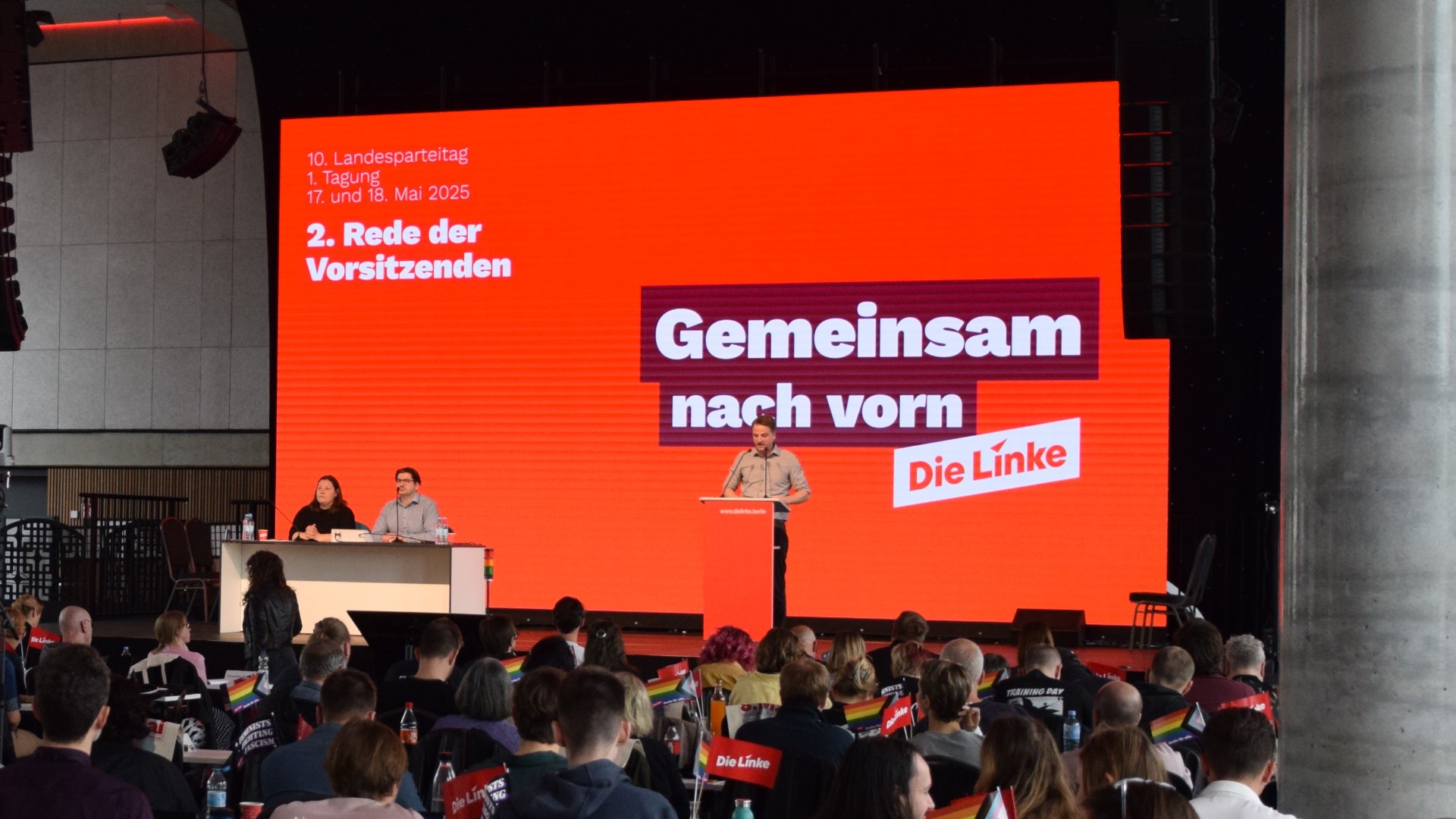
The victory of Die Linke (“The Left”) and the ongoing coalition talks in Berlin are making news in Israel, too. But the Israeli press has little to say about Berlin and a lot to say about Israel. A look right and left at polarization, lessons, and comparisons.
by Tomer Atir
A month has passed since the election to the Berlin House of Representatives. Berlin is a city-state and one of Germany’s 16 federal states, so its Governing Mayor is both mayor of the capital and head of a state government. Die Linke (“The Left”), which became the strongest party with 25.7% of the vote, is currently in talks with the Social Democrats (SPD, 12.1%) and the Greens (14.3%) to form a government. Together, the three parties hold 91 of the 153 seats in the state parliament.
The election campaign and the exploratory talks that followed were shaped not least by accusations of antisemitism and hatred of Israel against Die Linke, and particularly against its Berlin branch. This has caught the attention of the Israeli press.
How do Israeli commentators view the political developments in Berlin? How is the success of Die Linke interpreted? How are the party and its stance toward Israel described? And what comparisons are drawn, from both right and left? A press review.
“At the Center of the Debate”
Immediately after the election results were known, Kan, the public broadcasting corporation, reported that Israel is “at the center of the debate” in Berlin politics. Die Linke was described as a “radical left” party. The report did not mention any other topic except the impact of the antisemitism issue on forming a new government. “Two parties are under heavy pressure not to join a coalition led by ‘Die Linke’, and Israel’s name is frequently dragged into the issue,” it was written.
An article in Maariv (centrist mainstream newspaper) actually did address topics such as “The Left’s” housing plans, the origins of party leader Elif Eralp, and comparisons between her and New York City Mayor Zohran Mamdani. Mamdani is regularly in headlines in Israel, mostly in relation to his positions toward Israel—which are presented as antisemitic. The Maariv article, however, describes Eralp’s position on Israel as complex: “Eralp explicitly stated that Israel has a right to exist, condemned calls for violence against Israel… and even criticized an anti-Zionist decision by her party in Lower Saxony because it ignored, in her words, the Hamas massacre of October 7. At the same time, she is critical of Israeli policy in Gaza, emphasizes the need to protect Palestinians and Muslims in Berlin as well, and supports the creation of a twin-city alliance between Berlin and Ramallah alongside the existing one with Tel Aviv.”
“How the Extreme Left Conquered Berlin”
Later, the conservative website Mida published an article titled “How the Extreme Left Conquered Berlin.” Among other things, it presented Die Linke’s connections to pro-Palestinian activists and even Hamas supporters, together with its election rallies that included content against the “genocide” in Gaza and in favor of an intifada. The opposition to Israel is described as the result of the intersection between the East German left and the urban left: “Berlin is the only place where these two worlds intersect geographically and ideologically: From the urban center and west: comes the passion of youth and immigrants, who view the Palestinian struggle as a deeply personal, identity-based, and moral issue. From the east: come the historical burdens, anti-imperialist perceptions, and a deep sense of corruption against the German establishment.”
In an article published a few days ago on the religious-nationalist website Makor Rishon, the author celebrates the difficulties in coalition negotiations to establish a government led by “The Left.” Its headline: “The Left in Germany in an Existential Crisis: The Road to Power Passes Through Recognition of Israel.” The subject of the article is the internal contradiction the party faces. On the one hand, it came very close to power thanks to its proximity to protests surrounding Israel and the war in Gaza. On the other hand, to seize power it must compromise on this very issue.
Erel Segal, considered close to Israeli Prime Minister Benjamin Netanyahu, wrote a column in Israel Hayom criticizing the link between Marxist ideology, antisemitism and the denial of Israel, while simultaneously attacking the socialist movement in Israel. Another close figure, Moshe Cohen-Alia, compared in a Maariv column the political shift to the left in Berlin with a parallel rightward shift occurring in Israel: “While a young person in Berlin can study colonialism, power dynamics, and oppressed identities at university, an Israeli of the same age might spend three years in the army, and after October 7 also long months in reserve duty. These are completely different political experiences, which also produce a different political consciousness.”
Left-Wing Solidarity and a Debate on Facebook
And on the other hand, in Zo HaDerech—the weekly of the Israeli Communist Party, a column was published about two weeks after the elections expressing support for Die Linke. The author, an activist for “Israelis for Peace” in Berlin, argues that while there is anti-Israel sentiment and antisemitism in the party, the latter phenomenon is an all-German problem and the far-right is tainted by it. He defends “The Left’s” efforts to act against antisemitism and to “separate criticism of the genocide in Gaza from criticism of Israelis and Jews”—he and his friends even celebrated the Jewish holiday of Sukkot together with party leader Eralp. The author presents efforts to delegitimize the party as a “scare campaign” and “witch hunt” constructed by a distorted discourse in the media—including the Israeli media. According to him, in Israel, the left-wing party “The Democrats” and the Arab parties undergo a similar delegitimization campaign.
Read more
A surprisingly interesting discussion took place in the comments on a post on the Facebook page of the Berlin-based Israeli magazine Spitz Berlin. One commenter wondered why the “Alternative for Germany” (AfD) was described in the post as a far-right party, while next to Die Linke’s name the description extreme-left was not mentioned. The magazine’s response was that some AfD branches are classified by German authorities as “proven far-right” organizations, while in the case of the left, this is not the case. This discussion reveals the Israeli sensitivity to left-wing extremism—which is more closely identified with criticism of Israel, to the point of denying its right to exist.
What the Coverage Reveals About Israel
The way Berlin politics is covered in Israel is probably not going to influence the political agenda in Germany. However, it reflects part of the everyday Israeli experience and is influenced by the political identity of some of the writers. The Israeli right uses the elections in Berlin to highlight problems in the rival camp and to justify distancing itself from a West conquered by Muslims and progressives. The left—a minority, some of whom live abroad—is circling the wagons. And in the center: concerned voices identifying danger in the strengthening of political poles. What they all have in common: even when looking at Berlin politics, what matters most is how these developments will affect Israelis and what they mean for their own country.
Questions or suggestions? Write to us: info@bilateral-briefing.com