

Netanyahu’s Likud surprisingly in first place, the Arab parties stronger than ever, and no majority in sight: How German media are reading Israel’s election — and how they think the opposition could still unseat Netanyahu.
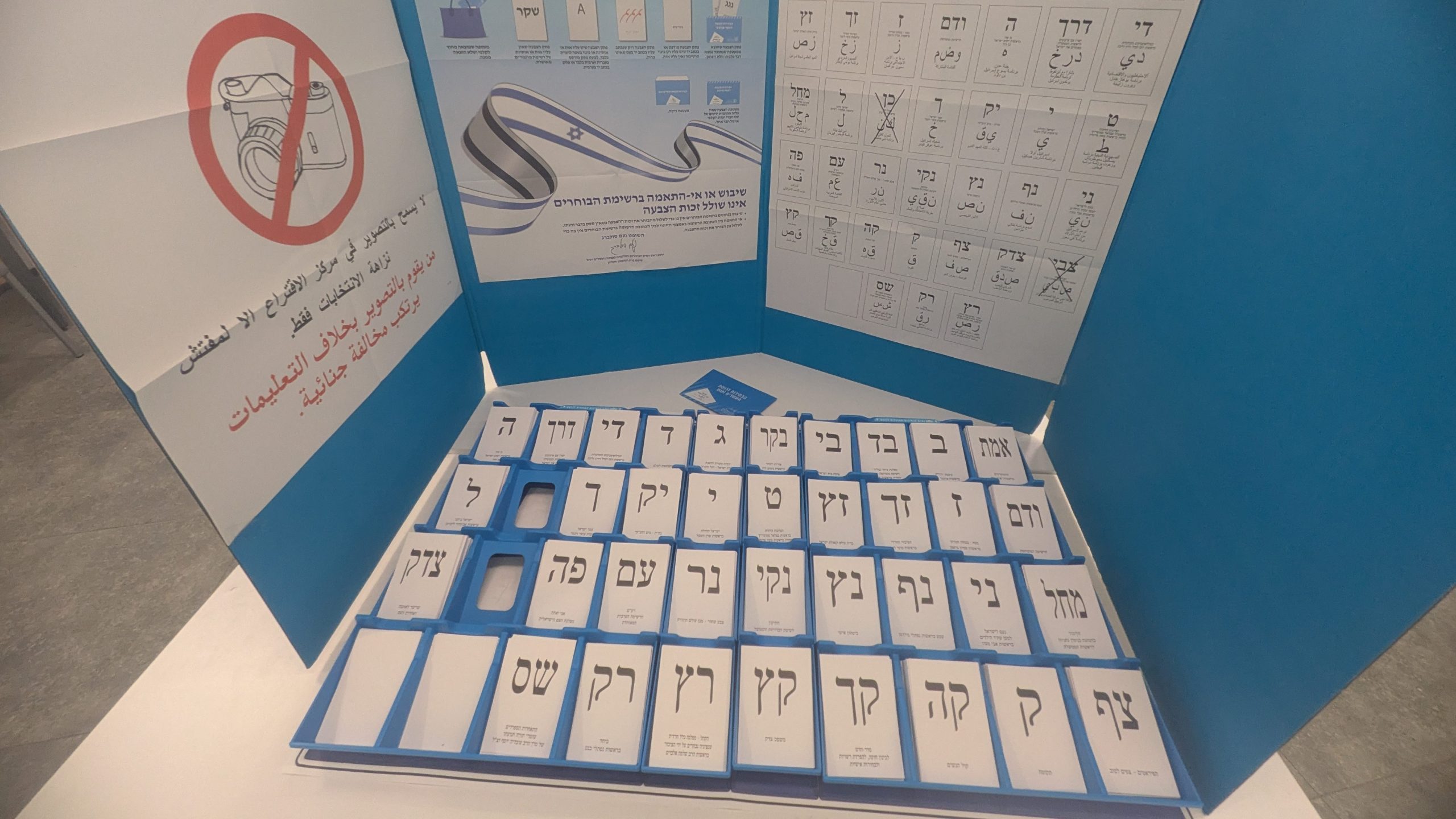
Israel has voted, and for now the result is a stalemate. On election night, exit polls still had the opposition alliance led by former IDF Chief of Staff Gadi Eisenkot narrowly ahead. According to the preliminary count, however, Prime Minister Benjamin Netanyahu’s camp is in the lead. Neither bloc reaches a majority of 61 of the Knesset’s 120 seats. Together, the Arab parties have won more seats than ever before.
How are German commentators reading the result? The tone is fairly uniform: Netanyahu’s strong showing is seen as the surprise of the election, the strong result of the Arab parties as the second. Many expect Israel to face a long period of limbo. And one demand runs through several pieces: Eisenkot’s camp must overcome its reservations and work with the Arab parties. Otherwise, a new election looms from which Netanyahu could emerge even stronger. A press review.
“A Bitter Political Poker Game”
On election night, both sides of the political spectrum were in a celebratory mood. But neither side’s math adds up, writes ARD correspondent Julio Segador for tagesschau, the flagship news program of German public broadcasting: “Neither bloc currently has a realistic chance of reaching the magic majority of 61 seats in the Knesset without the Arab parties.” Israel therefore faces “the exact opposite of stability: a bitter political poker game over posts, in which every single vote will be haggled over in the coming weeks.”
Netanyahu’s Ace up His Sleeve
Lisa Schneider, Middle East editor at the left-leaning Berlin daily taz, expects in her commentary that Netanyahu will do everything he can to stay in power. The fact that he won the most votes is likely to help him. From his perspective, the most obvious solution would be a unity government: Likud together with the Zionist opposition bloc.
According to Schneider, Netanyahu could force such an alliance through foreign policy. During the campaign, he relied above all on his relationship with U.S. President Donald Trump, and hardly anyone doubts that there will be another round in the war between Iran, the United States, and Israel. “The Iran war could be Netanyahu’s ticket into a unity government,” Schneider writes. If the war broke out again, ties with Washington could become exactly the “ace up his sleeve” that Netanyahu needs.
A “Victim Narrative” and an Uncomfortable Way Out
Thore Schröder’s analysis in the center-left newsmagazine Der Spiegel is considerably sharper. It is remarkable, he writes, that Netanyahu was able to win so many votes again, even though many Israelis hold him responsible for the failure to prevent the terror of October 7, 2023, and even though his record in government is “highly controversial in other respects as well.” For Schröder, this reflects the state of Israeli society: After the Hamas massacre, the country “took refuge in a victim narrative,” one that Netanyahu’s opponents and large parts of society helped to feed.
If Eisenkot and his partners still want to replace the long-serving prime minister, Schröder argues, they must change course: They would have to commit to cooperating with the moderate Arab parties, “that is, at least to outside support for a government,” and engage in an honest debate about the concerns and interests of the Arab population. The alternative, he writes, is a “grueling back-and-forth” at the end of which Netanyahu could emerge even stronger from another election.
Read more
The Arab Parties as Kingmakers
For Steffi Hentschke, the Arab parties are the real winners of the election. In her analysis for the liberal weekly Die Zeit, she speaks of the “gentle revenge” of Arab Israelis. Thanks to historically high turnout and the realization that their votes might prevent another Netanyahu term, the Arab minority has made itself “indispensable to the question of what kind of country Israel wants to be in the future.”
Writing in the liberal-conservative Neue Zürcher Zeitung, which is published in Switzerland and Germany, Johannes C. Bockenheimer sees this as “Eisenkot’s dilemma.” During the campaign, Eisenkot had explicitly ruled out a coalition with the Arab parties, as had many other politicians in his bloc. Even Naftali Bennett, who governed with the conservative Islamic Ra’am party in 2021, did not want to rely on Arab votes this time. “Yet it is precisely they who could provide a governing majority without Netanyahu — as voters had also been promised,” Bockenheimer writes.
A Scenario for Eisenkot
Christian Meier, Middle East correspondent for the center-right Frankfurter Allgemeine Zeitung, plays out another scenario. Eisenkot has spoken out against another election and ruled out a unity government with Likud, at least as long as Netanyahu leads the party. He has not, however, explicitly ruled out a minority government with outside support from Ra’am.
The fact that Eisenkot said action must now be taken “swiftly” could indicate, according to Meier, that he wants to form a caretaker minority government with the help of the Arab parties. That way, he could prevent Netanyahu from remaining caretaker prime minister through fruitless coalition talks and a possible further election.
Optimism at Die Zeit and Die Welt
Jan Roß sounds more optimistic. In his commentary for Die Zeit, written under the impression of the first exit polls, he sees the Netanyahu government’s time as up: “With the fall of the current coalition, there is once again a chance for reason and level-headedness, for an end to the permanent dramatization and hysteria that Netanyahu stands for.” Roß, too, considers cooperation between the opposition and the Arab parties conceivable — if not in a coalition, then in support of a minority government. For the moment, however, it is worth “first acknowledging the government’s defeat.” Since the votes were counted, though, things have been looking better again for the governing camp.
Jan Philipp Burgard, global reporter at the publisher Axel Springer, counts no fewer than four winners of the election in the conservative daily Die Welt (the piece also ran in Springer’s tabloid Bild): Netanyahu as the “surprise winner”; Eisenkot, who succeeded in winning the trust of many Israelis; the Arab parties; and above all the Israelis themselves. Turnout was the highest in more than 25 years, and around 70,000 Israelis traveled from abroad specifically to vote, since there is no absentee voting. Burgard’s conclusion: “Israelis have shown the whole world how much they care about democracy.”
Questions or suggestions? Write to us: info@bilateral-briefing.com